
You finally make it to town after five days in the backcountry. You have six hours before the last shuttle back to the trailhead.
That should be plenty of time to resupply, do laundry, eat a real meal, shower, charge all your devices and maybe (just maybe) relax with your feet up for an hour.
Four hours vanish in what feels like 45 minutes.
Suddenly you’re sprinting through the grocery aisles with a half-formed resupply list, wearing clothes that are still damp from the laundromat, inhaling a burger you can barely taste and you’ve barely checked off half your list. Your phone is at 34%. You forgot to mail that package home. The shuttle leaves in twenty minutes.
This is not poor planning. This is not your fault.
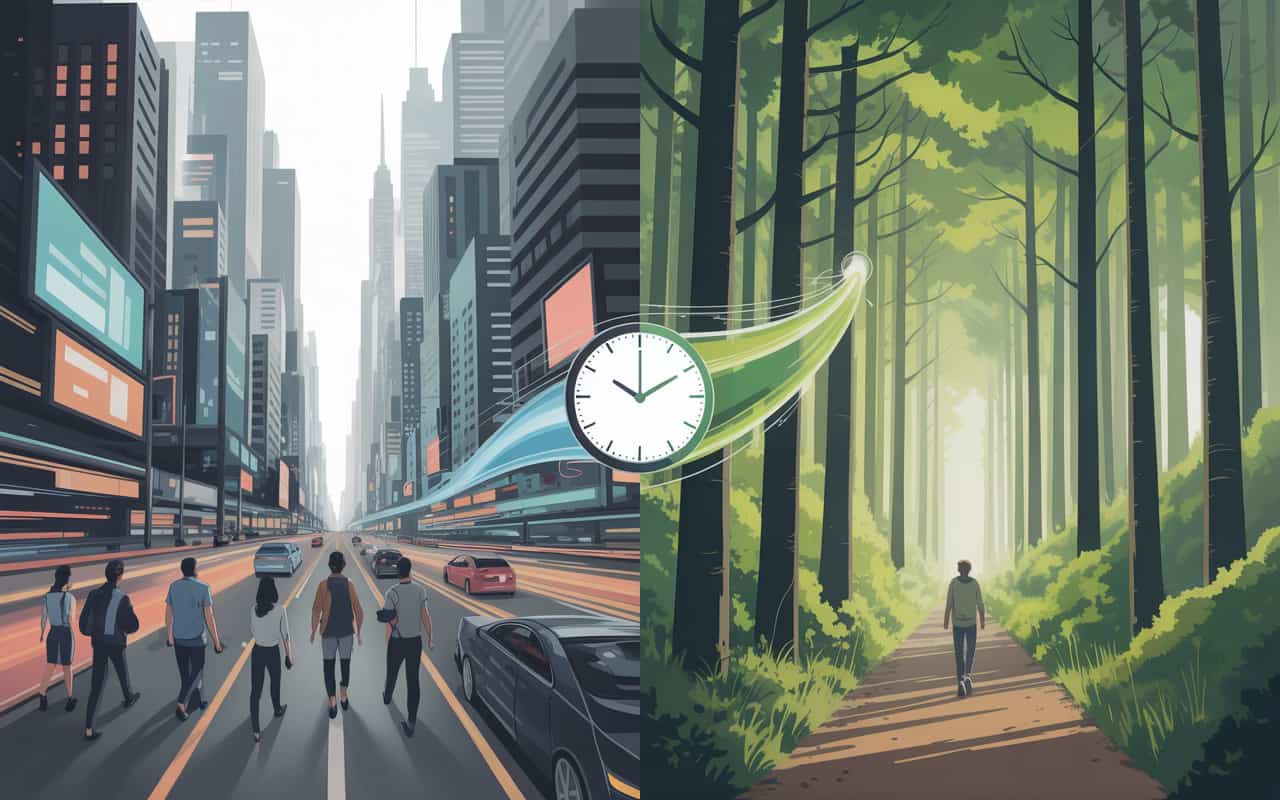
Town time moves at 3x speed. Trail time moves at 0.5x. This is not a metaphor.
The Time Warp is Real
On trail, a single afternoon can stretch into an entire epoch. You watch clouds reshape themselves across the sky. You count your footsteps without meaning to. You have a genuine 45-minute internal debate about whether to filter water now or wait until you get to camp in two miles. You notice the way light changes on leaves. Time becomes thick, tangible, almost chewy: something you move through rather than something that moves past you.
Your mind downshifts into a rhythm measured in miles per hour, water sources and the angle of the sun. There’s a strange luxury in this slowness. Boredom on trail isn’t really boredom; it’s spaciousness. Your thoughts have room to unfold. You’re living in what psychologists call “deep time,” where your attention isn’t fragmented into a thousand competing demands.
Then you hit town.
Welcome to the Acceleration Chamber
Town operates on a completely different temporal frequency. Suddenly you’re back in a world of business hours, shuttle schedules, laundromat cycles, restaurant wait times and the tyranny of the clock. Your brain, which has spent days or weeks operating in trail mode, hasn’t made the switch yet. You’re still moving at 2.5 mph internally while the world around you demands freeway speeds.
This is why town days are so uniquely exhausting. It’s not just the sensory overload of traffic, crowds and advertising. It’s not just the decision fatigue of choosing between seventeen types of potato chips after weeks of eating the same four foods. It’s the violent temporal whiplash of being yanked from one time signature into another.
You thought you’d feel rested. Instead, you feel like you just got hit by a truck made of errands.
Why This Happens (And Why It Matters)
The dissonance between trail time and town time is genuinely disorienting, and understanding why can help you manage it better.
On trail, you’ve adapted to what researchers call “chronobiology“: your body’s natural rhythms dictated by sunrise, sunset, hunger and fatigue. You’re operating closer to how humans existed for most of our history, responsive to immediate physical needs and environmental cues, not abstract schedules.
Town reintroduces “chronometry“: clock time, artificial schedules, synchronized social coordination. Your body is still in chronobiology mode. Your mind keeps trying to do chronometry. The mismatch is exhausting.
Add to this the fact that town involves navigating an overwhelming number of micro-decisions while your brain is still in “walk and think about nothing” mode and you’ve got a recipe for complete temporal disorientation. You return to trail feeling like you just experienced time travel, but backward, sideways and possibly through a dimension made entirely of grocery store fluorescent lighting.
Survival Tips for the Town Time Warp
Here’s what experienced thru-hikers learn, usually the hard way:
Prioritize time ruthlessly. Before you even get to town, write down your top three non-negotiables. Food, laundry, shower. Everything else is bonus. You probably won’t get to everything and that’s okay.
Build in buffer time. If the last shuttle is at 5 PM, plan like it leaves at 4 PM. Town time will eat that buffer and you’ll be grateful you built it in.
Eat first. Seriously. A hungry hiker in a grocery store will buy $80 worth of things that seemed essential at the time. Feed yourself a real meal before resupply and your food bag will be lighter and your wallet happier.
Accept that rest days aren’t restful. The real rest happens the day after you leave town, when you’re back on trail and your nervous system finally downshifts again. Plan accordingly.
Consider the zero-and-nero combo. If you can swing it, a “zero” (zero miles, full day in town) followed by a “nero” (nearly zero, short mileage day leaving town) gives you time to both get things done and actually decompress.
The Reentry
The strangest part? After town, you need a day to recover just to readjust to trail time. That first day back, you’re still buzzing with town energy, checking your phone compulsively even though you have no signal, walking too fast, thinking too much. Your body is on trail but your mind is still dodging traffic and calculating laundry cycles.
Give it a day. By the second day back, trail time reasserts itself. Your thoughts slow down. Your breath deepens. The thick, chewy quality of time returns. You remember why you’re out here.
And then, five days later, you’ll do it all over again.
Does anyone else feel like they need a day to recover from town? You’re not alone. It’s not a bug in your hiking; it’s a feature of being human in two radically different worlds. The trick is knowing which world you’re in and giving yourself grace for the whiplash in between.
What’s your town time survival strategy? Have you found ways to make the transition smoother or do you just embrace the chaos?